SonoStudy: Meta-analysis of 9 trials – ultrasound use for peripheral IVs in kids and adults #FOAMed

Not that we didnt already know this, but at least we have more data to say it is so – in a recent study in Annals of Emergency medicine – a meta analysis reviewed 9 trials – both kids and adults.

This concept has been getting a lot of press, and many of my ultrasound enthusiast friends have passed this around. It’s good to know the concept – and use it when you are in a conversation with someone who thinks the blind technique it still the way to go.

“Pediatric trials yielded conflicting data, the authors reported February 18 online in Annals of Emergency Medicine, but there appeared to be significantly fewer attempts and shorter procedure times when ultrasound guidance was used in the emergency department, as well as significantly decreased risk of first-attempt failure, reduced attempts, and shorter procedure time when ultrasound guidance was used in the operating room…..”Ultrasonographically guided peripheral intravenous cannulation may perform better in the pediatric population because failure rates with the traditional method are much higher in children than adults,” the researchers note. “Ultrasonography may not be as beneficial in adults, in whom target vessels are easier to locate.” – Now, these trials were from operating room patients, where the setting is a bit more controlled, the patients may be a bit different in their difficult IV access spectrum – but the authors still suggest that if faced with a difficult IV – use ultrasound.

Below is the abstract:

Study objective

Peripheral intravenous cannulation is procedurally challenging and painful. We perform a systematic review to evaluate ultrasonographic guidance as an aid to peripheral intravenous cannulation.

Methods

We searched MEDLINE, Cochrane Central Register of Controlled Trials, EMBASE, Cumulative Index to Nursing and Allied Health Literature (CINAHL), Web of Science, ClinicalTrials.gov, and Google.ca. We included randomized trials evaluating ultrasonographically guided peripheral intravenous cannulation and reporting risk of peripheral intravenous cannulation failure, number of attempts, procedure time, or time from randomization to peripheral intravenous cannulation. We separately analyzed pediatric and adult data and emergency department (ED), ICU, and operating room data. Quality assessment used the Cochrane Risk of Bias Tool.

Results

We identified 4,664 citations, assessed 403 full texts for eligibility, and included 9 trials. Five had low risk, 1 high risk, and 3 unclear risk of bias. A pediatric ED trial found that ultrasonography decreased mean difference (MD) in the number of attempts (MD −2.00; 95% confidence interval [CI] −2.73 to −1.27) and procedure time (MD −8.10 minutes; 95% CI −12.48 to −3.72 minutes). In an operating room pediatric trial, ultrasonography decreased risk of first-attempt failure (risk ratio 0.23; 95% CI 0.08 to 0.69), number of attempts (MD −1.50; 95% CI −2.52 to −0.48), and procedure time (MD −5.95; 95% CI −10.21 to −1.69). Meta-analysis of adult ED trials suggests that ultrasonography decreases the number of attempts (MD −0.43; 95% CI −0.81 to −0.05). Ultrasonography decreased risk of failure (risk ratio 0.47; 95% CI 0.26 to 0.87) in an adult ICU trial.

Conclusion

Ultrasonography may decrease peripheral intravenous cannulation attempts and procedure time in children in ED and operating room settings. Few outcomes reached statistical significance. Larger well-controlled trials are needed.

For more info and a how-to for ultrasound guided procedures, including ultrasound-guided peripheral IV and central IV acces – go here.
SonoStudy: Emergency docs detect small bowel obstruction by US – as good as radiologists #FOAMed

In a recent article in the European Journal of Emergency medicine, the authors showed that emergency physicians are just as good as radiologists in detecting small bowel obstruction by bedside US. Now, it’s not hard to do, nor is it hard to see it. First off, use your abdominal low frequency probe, and evaluate the abdomen in different quadrants. Normally, the bowel appears as a single circular hypoechoic layer (muscle layer) surrounding hyperechoic bowel contents of gas and food particles. The normal thickness of this layer during the contraction stage of peristalsis is 2-3 mm. The hypoechoic normal wall becomes thinner during peristalsis when the bowel is relaxed.

In small bowel obstruction- looking for dilated fluid filled loops of bowel with hyperechoic (bright) spots within it that may have back and forth peristalsis and a thicker intestinal wall (decreased persitalsis is a late finding) – color doppler gives info about blood flow in the walls of the intestine – and you may even see a transition point. Timothy Jang and team studied ultrasound compared to Xray for SBO and found that ultrasound is better, like WAYYYY better (higher sensitivity and specificity) – hmmm, interesting – Some things to consider: fluid-filled loops (good for US), but air-filled loops may not be so good. Ileus and SBO may appear similarly, so consider thinking of causes of ileus as well (gallstone ileus, etc), and a thickened wall may just be colitis, but that along with dilated loops and back and forth persitalsis with a transition point seen – more likely SBO.

This is what it would look like (and there are more clips to view – thanks to SonoCloud)

The abstract of the study follows:

“Objective: Our objective was to study the accuracy of emergency medicine [(EM) bedside ultrasonography (BUS)] and radiology residents performed ultrasonography (RUS) in patients with suspected mechanical small bowel obstruction (SBO).

Methods: After a 6-h training program, from January to June 2009, four EM residents used BUS to prospectively evaluate the patients presenting to the emergency department with suspected SBO. Then, patients underwent RUS. Outcome was determined by surgical findings if they were operated upon or self-reported the condition upon telephone follow-up at 1-month. BUS and RUS results were compared with χ2 testing.

Results: Of the 174 enrolled patients, 90 patients were BUS-positive. Of these, surgical findings agreed with the BUS findings in 84 patients. In 78 cases, BUS was negative, and 76 of these patients had benign clinical courses. Six patients were excluded from the study. The sensitivity, specificity, positive predictive value, negative predictive value, and likelihood ratio for BUS were 97.7, 92.7, 93.3, 97.4, and 13.4%, respectively. Sensitivity, specificity, positive predictive value, and negative predictive value for RUS were 88.4, 100, 100, and 89.1%, respectively. The diagnostic accuracy of BUS and RUS were not statistically different from each other (κ=0.81). The presence of dilated small bowel loops (>25 mm in jejunum or >15 mm in ileum) was the most sensitive (94%) and specific (94%) sonographic finding for SBO.

Conclusion: Abdominal sonography for the diagnosis of SBO is a new application of BUS in the emergency department. EM residents can diagnose SBO using BUS with a high-degree of accuracy, comparable with that of radiology residents.”

To read the UltrasoundPodcast guys speak on the subject, click here>

To see them do it, see below:

SonoStudy and Review: The Beta hCG, the Ectopic, and the Ultrasound Findings – do they correlate?

In a recent article in the Journal of Ultrasound in Medicine (through AIUM), a study was done that illustrates exactly what we all experience in practice – an ectopic pregnancy can occur at any beta hCG level….AND a normal pregnancy can result despite a higher bHCG and no IUP seen. The conversations with the radiologists who still believe in “screening” who should and should not be scanned based solely on the beta hCG level will minimize – so we hope. The lowest beta hcg I have ever seen with a diagnosed ectopic? Brace yourselves…….152 ! There have been other case reports and cohort multi-site studies that you can read herehere, here, and here about low hCG and diagnosis of ectopic pregnancy. ACEP even has an article on it. But what if the beta hCG is high? …and you see nothing in the uterus on your ultrasound? There was a study done in 2011 by Wang, et al out of UCSF that discussed this too, asking if we should increase the discriminatory zone. There are also studies that show if you DO see something in the uterus, what does that mean in relation to ectopic pregnancy? Well, first, let’s talk physiology – Now, hCG is made by the syncytiotrophoblasts of the placenta after fertilization occurs, and correlates with the size and developing of the fetus…. well, Im going to stop there, as the only reason I stated that was to type “syncytiotrophoblasts” as I rarely have the opportunity to do so (insert sarcasm).

There is, however, a term used to describe the maternal serum hCG level above which a gestational sac should be consistently visible on transvaginal sonography – “discriminatory zone” – coined in the 1980s (yup, that’s right, 30 years ago!). This was thought to be 1,000, 1,500, or 2,000 on transvaginal ultrasound (and 3,600 or 6,000 on transabdominal ultrasound) depending on the study you read. So, if the hCG is above that zone and no IUP is seen – then you have yourself an ectopic pregnancy ….until proven otherwise! – and doctors would think treating for ectopic is the appropriate next step. Then there was a hiccup – There was a study that showed an HCG of 2,000 may not mean ectopic as 33% of the study’s subjects had a normal IUP after having no IUP on ultrasound when they were above that discriminatory zone. Oopsy! But, the prior studies all kinda had a possible gestational sac, but defined an IUP as the presence of a double decidua sign or yolks sac. So, this study wanted to know if there was no gestational sac and the bHCG was above this discriminatory zone, will there be an IUP, and if so, then what is the prognosis – in other words, is this discriminatory zone be valid?

“Objectives—The human chorionic gonadotropin (hCG) discriminatory level—the maternal serum β-hCG level above which a gestational sac should be consistently visible on sonography in a normal pregnancy—has been reported to be 1000 to 2000 mIU/mL for transvaginal sonography. We assessed whether a woman with a β-hCG above 2000 mIU/mL and no intrauterine fluid collection on transvaginal sonography can subsequently be found to have a live intrauterine gestation and, if so, what the prognosis is for the pregnancy.

 Methods—We identified all women scanned between January 1, 2000, and December 31, 2010, who met the following criteria: serum β-hCG testing and transvaginal sonography were performed on the same day; β-hCG was positive and sonography showed no intrauterine fluid collection; and a live intrauterine pregnancy was subsequently documented. We tabulated the β-hCG levels in these cases and assessed pregnancy outcome.

Results—A total of 202 patients met the inclusion criteria, including 162 (80.2%) who had β-hCG levels below 1000 mIU/mL on the day of the initial scan showing no intrauterine fluid collection, 19 (9.4%) with levels of 1000 to 1499, 12 (5.9%) 1500 to 1999, and 9 (4.5%) above 2000 mIU/mL. There was no significant relationship between initial β-hCG level and either first-trimester outcome or final pregnancy outcome (P> .05, logistic regression analysis and Fisher exact test). The highest β-hCG was 6567 mIU/mL, and the highest value that preceded a liveborn term baby was 4336 mIU/mL.

[Also: “Comparing outcomes in cases with β-hCG below 1000 versus above 1000 mIU/mL also showed no significant difference: 89.9% (125 of 139) live at the end of the first trimester in the low hCG group versus 88.6% (31 of 35) live in the high hCG group; 86.6% (110 of 127) liveborn in the low hCG group versus 80.6% (25 of 31) liveborn in the high hCG group (P > .05 for both comparisons Fisher exact test)]”

Conclusions—The hCG discriminatory level should not be used to determine the management of a hemodynamically stable patient with suspected ectopic pregnancy, if sonography demonstrates no findings of intrauterine or ectopic pregnancy.

New Guidelines published in NEJM in Oct 2013 have changed the criteria in order to reduce the risk of prematurely stating a pregnancy is non-viable.

 A great discussion on this also heard here BroomeDocs’ Casey Parker: here

For a great 5 minute talk on Ectopic pregnancy and how to identify it by ultrasound, see Dr. Phil Perera’s Soundbytes insert – but, as the studies above suggest, if you see no IUP despite an hCG above the discriminatory zone, there may not be an ectopic pregnancy – make sure to look around the adnexal region, and have close follow up with the Ob/Gyn doctor.

SonoStudy: Thoracic ultrasound in identifying pneumothorax progression in the intubated – the lung point

In the Feb 2013 issue of Chest, Oveland et al studied porcine models, introducing air at incremental levels to identify if thoracic ultrasound is as accurate as CT scanning for the detection pneumothorax progression in the intubated patient. They found that “the accuracy of thoracic ultrasonography for identifying the lung point (and, thus, the PTX extent) was comparable to that of CT imaging. These clinically relevant results suggest that ultrasonography may be safe and accurate in monitoring PTX progression during positive pressure ventilation.”

“Background:  Although thoracic ultrasonography accurately determines the size and extent of occult pneumothoraces (PTXs) in spontaneously breathing patients, there is uncertainty about patients receiving positive pressure ventilation. We compared the lung point (ie, the area where the collapsed lung still adheres to the inside of the chest wall) using the two modalities ultrasonography and CT scanning to determine whether ultrasonography can be used reliably to assess PTX progression in a positive-pressure-ventilated porcine model.

Methods:  Air was introduced in incremental steps into five hemithoraces in three intubated porcine models. The lung point was identified on ultrasound imaging and referenced against the lateral limit of the intrapleural air space identified on the CT scans. The distance from the sternum to the lung point (S-LP) was measured on the CT scans and correlated to the insufflated air volume.

Results:  The mean total difference between the 131 ultrasound and CT scan lung points was 6.8 mm (SD, 7.1 mm; range, 0.0-29.3 mm). A mixed-model regression analysis showed a linear relationship between the S-LP distances and the PTX volume (P < .001).

Conclusions:  In an experimental porcine model, we found a linear relation between the PTX size and the lateral position of the lung point. The accuracy of thoracic ultrasonography for identifying the lung point (and, thus, the PTX extent) was comparable to that of CT imaging. These clinically relevant results suggest that ultrasonography may be safe and accurate in monitoring PTX progression during positive pressure ventilation.”

Full article found here.

To see the lung point, you visualize the pleural line using the linear probe (indicator toward the patient’s head) starting from anterior chest wall (2nd intercostal space, mid-clavicular line) to inferior-lateral chest wall, and look out for the area where the lack of lung sliding or comet tail artifacts reverts back to normal lung sliding with comet tail artifacts. Blaivas, et al, studied this, showing that bedside ultrasound can detect size of pneumothorax through identification of the lung point location. Below is a video fo the lung point:

SonoStudy & Review of literature: Rapid Lung/cardiac/IVC – differentiates causes of acute dyspnea

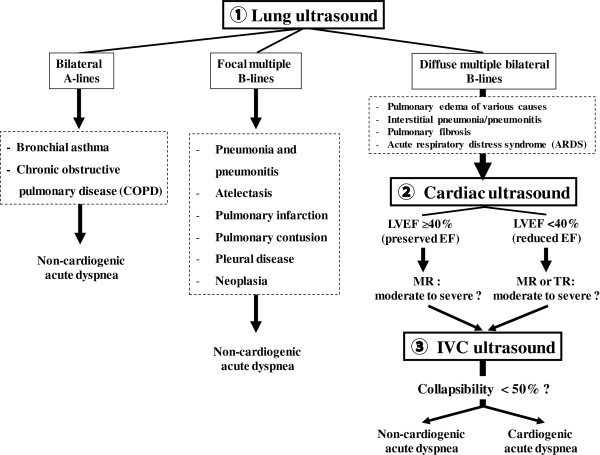
A recent study in cardiovascular medicine … a concept that has been highlighted in varying ways from prior studies (by Liteplo (ETUDES study), Lichtenstein (all of his studies, actually), Volpicelli (ILC-LUS international consensus), and Manson with the RADIUS study/protocol), continues to conclude that rapid bedside ultrasound of lung/cardiac/IVC can help differentiate causes of acute dyspnea. The state: “The present study demonstrated that rapid evaluation by lung-cardiac-inferior vena cava (LCI) integrated ultrasound has a higher diagnostic accuracy for differentiating acute dyspnea due to AHFS from pulmonary acute dyspnea (including COPD/asthma, pulmonary fibrosis, and ARDS) compared with lung ultrasound either alone or in combination with plasma BNP assay. These findings suggest that LCI integrated ultrasound has become a fundamental tool for diagnostic evaluation of patients with acute dyspnea and selection of early treatment in the emergency setting.”

The algorithm below is what they used:

1476-7120-10-49-1

ABSTRACT:

BACKGROUND: Rapid and accurate diagnosis and management can be lifesaving for patients with acute dyspnea. However, making a differential diagnosis and selecting early treatment for patients with acute dyspnea in the emergency setting is a clinical challenge that requires complex decision-making in order to achieve hemodynamic balance, improve functional capacity, and decrease mortality. In the present study, we examined the screening potential of rapid evaluation by lung-cardiac-inferior vena cava (LCI) integrated ultrasound for differentiating acute heart failure syndromes (AHFS) from primary pulmonary disease in patients with acute dyspnea in the emergency setting.

METHODS:

Between March 2011 and March 2012, 90 consecutive patients (45 women, 78.1 +/- 9.9 years) admitted to the emergency room of our hospital for acute dyspnea were enrolled. Within 30 minutes of admission, all patients underwent conventional physical examination, rapid ultrasound (lung-cardiac-inferior vena cava [LCI] integrated ultrasound) examination with a hand-held device, routine laboratory tests, measurement of brain natriuretic peptide, and chest X-ray in the emergency room.

RESULTS:

The final diagnosis was acute dyspnea due to AHFS in 53 patients, acute dyspnea due to pulmonary disease despite a history of heart failure in 18 patients, and acute dyspnea due to pulmonary disease in 19 patients. Lung ultrasound alone showed a sensitivity, specificity, negative predictive value, and positive predictive value of 96.2, 54.0, 90.9, and 75.0%, respectively, for differentiating AHFS from pulmonary disease. On the other hand, LCI integrated ultrasound had a sensitivity, specificity, negative predictive value, and positive predictive value of 94.3, 91.9, 91.9, and 94.3%, respectively.

CONCLUSIONS:

Our study demonstrated that rapid evaluation by LCI integrated ultrasound is extremely accurate for differentiating acute dyspnea due to AHFS from that caused by primary pulmonary disease in the emergency setting.

SonoStudy: >12,000 kids – Identifying factors putting kids at low risk, not needing CT after trauma

There has been quite a bit of press lately on this –  Here and Here – And for good reason. With the ALARA principle, and being a pediatric population which has been studied so many times with regard to trauma and the need for CT, a recent study by Holmes et al published in Annals of Emergency Medicine did a multi-site study enrolling >12,000 kids and identified 7 factors that places children at very low risk for injury not requiring abdominal CT. A prior post discusses a study done by the same author and my thoughts of pediatric US in trauma. BTW – Dr. Holmes also discusses low risk factors for adult patients in a prior study too.

The prediction rule for pediatric patients consisted of (in descending order of importance):
No evidence of abdominal wall trauma or seat belt sign,
Glasgow Coma Scale score greater than 13,
No abdominal tenderness,
No evidence of thoracic wall trauma,
No complaints of abdominal pain,
No decreased breath sounds, and
No vomiting.

Now, I dont know about you, but to me it is quite obvious – we just now have a nicely powered study that we can use for all the doctors who want to CT despite all of the above being negative. The authors say that if any one of the above exist then a decision by the physician should be made as to what the next best management step would be – observation period with serial exams, ultrasound (holla!), CT – are all options depending on clinical judgement. Below is the abstract:

Study objective: We derive a prediction rule to identify children at very low risk for intra-abdominal injuries undergoing acute intervention and for whom computed tomography (CT) could be obviated.
Methods: We prospectively enrolled children with blunt torso trauma in 20 emergency departments. We used binary recursive partitioning to create a prediction rule to identify children at very low risk of intra-abdominal injuries undergoing acute intervention (therapeutic laparotomy, angiographic embolization, blood transfusion for abdominal hemorrhage, or intravenous fluid for ≥2 nights for pancreatic/gastrointestinal injuries). We considered only historical and physical examination variables with acceptable interrater reliability.
Results: We enrolled 12,044 children with a median age of 11.1 years (interquartile range 5.8, 15.1 years). Of the 761 (6.3%) children with intra-abdominal injuries, 203 (26.7%) received acute interventions. The prediction rule consisted of (in descending order of importance) no evidence of abdominal wall trauma or seat belt sign, Glasgow Coma Scale score greater than 13, no abdominal tenderness, no evidence of thoracic wall trauma, no complaints of abdominal pain, no decreased breath sounds, and no vomiting. The rule had a negative predictive value of 5,028 of 5,034 (99.9%; 95% confidence interval [CI] 99.7% to 100%), sensitivity of 197 of 203 (97%; 95% CI 94% to 99%), specificity of 5,028 of 11,841 (42.5%; 95% CI 41.6% to 43.4%), and negative likelihood ratio of 0.07 (95% CI 0.03 to 0.15).
Conclusion: A prediction rule consisting of 7 patient history and physical examination findings, and without laboratory or ultrasonographic information, identifies children with blunt torso trauma who are at very low risk for intra-abdominal injury undergoing acute intervention. These findings require external validation before implementation.

SonoStudy: Emergency Physicians can estimate gestational age in 1st trimester pregnancies

I recently posted about how emergency physicians can decrease the length of stay of patients with first trimester vaginal bleeding/pelvic pain (ruling out ectopic pregnancy) by performing a bedside pelvic ultrasound, which also had a couple cases to ponder about. As emergency physicians are getting more and more savvy with bedside ultrasound, it may benefit the patient’s future care if we are also able to tell them the gestational age. Well, this study (and great review) on emergency physicians-performed ultrasound estimating gestational age (compared with radiology results) highlights exactly that! And, guess what? we CAN estimate gestational age – shocking, I know. Below is the abstract:

ABSTRACT:

BACKGROUND: Patient reported menstrual history, physician clinical evaluation, and ultrasonography are used to determine gestational age in the pregnant female. Previous studies have shown that pregnancy dating by last menstrual period (LMP) and physical examination findings can be inaccurate. Radiology department ultrasound has proven to be the most accurate way of determining gestational age. The aim of this study is to determine the accuracy of emergency department ultrasound as an estimation of gestational age (EDUGA) in an emergency department (ED) population.

METHODS:

A prospective convenience sample of ED patients presenting in the first trimester of pregnancy (based upon self-reported LMP) regardless of their presenting complaint were enrolled. EDUGA was compared to gestational age estimated by ultrasound performed in the department of radiology (RGA) as the gold standard. Pearson’s product moment correlation coefficient was used to determine the correlation between EDUGA compared to RGA.

RESULTS:

Sixty-eight pregnant patients presumed to be in the 1st trimester of pregnancy based upon self-reported LMP consented to enrollment. When excluding the cases with no fetal pole, the median discrepancy of EDUGA versus RGA was 2 days (interquartile range (IQR) 1 to 3.25). The correlation coefficient of EDUGA with RGA was 0.978. When including the six cases without a fetal pole in the data analysis, the median discrepancy of EDUGA compared with RGA was 3 days (IQR 1 to 4). The correlation coefficient of EDUGA with RGA was 0.945.

CONCLUSION:

Based on our comparison of EDUGA to RGA in patients presenting to the ED in the first trimester of pregnancy, we conclude that emergency physicians are capable of accurately performing this measurement. Emergency physicians should consider using ultrasound to estimate gestational age as it may be useful for the future care of that pregnant patient.

SonoStudy: Bedside Pelvic Ultrasound decreases length of stay in the emergency department

In a recent study in Pediatric Emergency Care, the folks at newark Beth Israel in New Jersey studied whether performing a pelvic ultrasound decreases length of stay. Now, we all can appreciate this – you have a pregnant patient with first trimester vaginal bleeding or abdominal pain, you see an intrauterine pregnancy without any risks/signs of heterotopic (which is incredibly rare anyway) – you’re done! You dont even have to wait for the beta hCG! Of course that decreases length of stay! Now, this wasnt the first study of it’s kind. Another study by Blaivas et al. basically did the same thing… 13 years ago! And by Burgher…. 16 years ago. And by Shih…. 16 years ago! There was a great review of pelvic ultrasound done in 2009 that shows its accuracy and utility too.

Well, here is what they state: abstract below

“OBJECTIVES: Diagnostic ultrasounds by emergency medicine (EM) and pediatric emergency medicine (PEM) physicians have increased because of ultrasonography training during residency and fellowship. The availability of ultrasound in radiology departments is limited or difficult to obtain especially during nighttime hours. Studies have shown that EM physicians can accurately perform goal-directed ultrasound after appropriate training. The goal of this study was to compare the length of stay for patients receiving an ultrasound to confirm intrauterine pregnancies. The hypothesis of this study is that a bedside ultrasound by a trained EM/PEM physician can reduce length of stay in the emergency department (ED) by 1 hour.

METHODS: This was a case cohort retrospective review for patients aged 13 to 21 years who received pelvic ultrasounds in the ED during 2007. Each patient was placed into 1 of 2 groups. Group 1 received bedside ultrasounds done by institutionally credentialed EM/PEM attending physicians. Group 2 received radiology department ultrasound only. Each group had subanalysis done including chief complaint, time of presentation, time to completion of ultrasound, length of stay, diagnosis, and disposition. Daytime was defined as presentation between 7 AM and 9 PM when radiology ultrasound technologists were routinely available.

RESULTS: We studied 330 patients, with 244 patients (74%) in the bedside ultrasound group. The demographics of both groups showed no difference in age, presenting complaints, discharge diagnoses, and ultimate disposition. Group 1 had a significant reduction (P < 0.001) in time to complete the ultrasound compared with group 2 (mean, 82 minutes [range, 1-901 minutes] vs 149 minutes [range, 7-506 minutes]) and length of stay (142 [16-2268] vs 230 [16-844]). Of those presenting during the day (66%), group 1 showed a significant reduction in length of stay (P < 0.001) compared with group 2 (220 [21-951] vs 357 [156-844]). Of those who presented at night (34%), group 1 showed a significant reduction in length of stay (P < 0.002) compared with group 2 (270 [16-2268] vs 326 [127-691]).

CONCLUSIONS: The use of ED bedside ultrasound by trained EM/PEM physicians produced a significant reduction in length of stay in the ED, regardless of radiology ultrasound technologist availability.”

Some interesting cases for your review:

SonoCase: 30 yr old with pelvic pain, LMP 5 weeks ago, stable vitals, mild tenderness in suprapubic area, pelvic exam normal. Your Transabdominal pelvic view on ultrasound shows the below. What do you do next?

Well, we see a full bladder – which is a must if you actually care about your pelvic views – and we see a gestational sac with a double decidua sign – the earliest sign of an intrauterine pregnancy, BUT it is not enough to diagnosis a definitive intrauterine pregnancy – you need a yolk sac within your gestational sac to say that! So, get your endocavitary ultrasound probe and take a look (after emptying the bladder), you may just see the yolk sac!

SonoCase: 24 yr old with pelvic pain, LMP 6 weeks ago, stable vitals, mild tenderness in suprapubic area, pelvic exam normal. Your Transabdominal pelvic view on ultrasound shows below. What is the diagnosis? What do you do next?


Well, there is an empty bladder (unfortunately), so the visualization is not its best, but while we slowly fan through the pelvis there is a fluid filled circular cystic-like structure with mild acoustic enhancement (brightness deep to it) which allows you to also see a gestational sac within the uterus. There is an ovarian cyst. Is that what’s causing the pelvic pain? Are you sure it’s not an ectopic? Not yet – get your endocavitary probe now that the bladder is empty and take a look for the yolk sac or fetal pole. If the fetal pole has cardiac activity visualized then we can say it is a LIVE intrauterine pregnancy.

SonoStudy: Prehospital Chest Ultrasound matters!

In a recent study published in Journal of Emergency Medicine, there is a high powered study with quite a few patients on whether prehospital chest ultrasound changes management, destination, or intervention. Once again, a great study highlighting how point of care ultrasound should be used by prehospital providers.

“BACKGROUND:

Due to advancements in technology, the use of a portable ultrasound (US) machine in the out-of-hospital setting is increasingly feasible. It has diagnostic and therapeutic advantages and may improve the management and treatment of patients. It can be used in-flight and can be easily taught to flight clinicians who have little previous experience with this modality.

STUDY OBJECTIVES:

The goal of this study was to evaluate the impact of ultrasound chest examinations on the care of patients treated by a Helicopter Emergency Medical Service (HEMS).

METHODS:

Since 2007, portable US has been used by the HEMS of Nijmegen, The Netherlands. Data on every air medical flight are routinely collected in a database. Every portable US examination of the chest performed between 2007 and 2010 was reviewed for this study. Data on patient characteristics, properties of US examinations, US diagnoses, and impact on medical treatment were collected and analyzed.

RESULTS:

Of a total of 2572 patients, 326 portable US examinations of the chest were performed on 281 (11%) patients. The mean duration of a portable US examination was 2.77 (SD 1.30) min, and the duration decreased over time. After the US examination, the plan for treatment changed in 60 (21%) patients. In 10 patients (4%) the plan to place a chest tube was abandoned. In 10 patients (4%) the initially selected destination for definitive care changed, and it changed to a lower-level hospital more often than to a higher-level one. In 9 patients (3%), cardiopulmonary resuscitation was stopped and in 31 patients there were other changes.

CONCLUSION:

Out-of-hospital US examinations can alter and improve treatment decisions and destinations for definitive care.”

SonoStudy: Flat IVC predictor of poor prognosis in trauma – A-B-C-D-Echo in Trauma!

A recent study on the IVC and trauma and acute surgical patients was done by Ferrada et al, and despite the giggles I get when I read it and how they describe the IVC as “Fat ” or “Flat”, it is an important topic to discuss as it is one of the few articles out there that correlate the iVC to trauma patients and acute surgical patients. First off, it is a retrospective study, which can make it difficult to assess patients with similar factors without other factors coming into play (but when is that NOT the case, honestly?) They did compare the IVC in all patients and studied those patients who seemed sick as well – ICU admission, immediate surgery need, transfusion needed. The power of the study was good but not great – 101 patients studied – varying in type of trauma and surgical need. There was a previous study published in the Journal of Trauma in 2011 that stated CT evidence of flat IVC was an indicator for hypovolemia and  poor prognostic indicator for blunt solid organ injuries – this confirmed a study done in 2010 stating the same thing. Thankfully, ultrasound can get you that information much more immediately than CT!

This month, another study by the same author (Ferrada) in the Journal of trauma and acute care surgery entitled A-B-C-D-Echo (I know, love it!) stated that adding limited transthoracic echo, including the IVC, will benefit trauma patients with results showing “Flat inferior vena cava was associated with an increased incidence of ICU admission (p < 0.0076) and therapeutic operation (p < 0.0001). Of the 148 patients, 27 (18%) had LTTE results indicating euvolemia. The diagnosis in these cases was head injury (n = 14), heart dysfunction (n = 5), spinal shock (n = 4), pulmonary embolism (n = 3), and stroke (n = 1). Of the patients, 121 had LTTE results indicating hypovolemia. Twenty-eight hypovolemic patients had a negative or inconclusive Focused Assessment with Sonography for Trauma examination finding (n = 18 penetrating, n = 10 blunt), with 60% having blood in the abdomen confirmed by surgical exploration or computed tomographic scan. Therapy was modified as a result of LTTE in 41% of cases. Strikingly, in patients older than 65 years, LTTE changed therapy in 96% of cases.”

Below are the Abstracts of the studies highlighted by Ferrada:

“Flat inferior vena cava (IVC) on ultrasound examination has been shown to correlate with hypovolemic status. We hypothesize that a flat IVC on limited echocardiogram (LTTE) performed in the emergency room (ER) correlates with poor prognosis in acutely ill surgical patients. We conducted a retrospective review of all patients undergoing LTTE in the ER from September 2010 until June 2011. IVC diameter was estimated by subxiphoid window. Flat IVC was defined as diameter less than 2 cm. Fat IVC was defined as diameter greater than 2 cm. Need for intensive care unit admission, blood transfusion requirement, mortality, and need for emergent operation between patients with flat versus Fat IVC were compared. One hundred one hypotensive patients had LTTE performed in the ER. Average age was 38 years. Admission diagnosis was blunt trauma (n = 80), penetrating trauma (n = 13), acute care surgery pathology (n = 7), and burn (n = 1). Seventy-four patients had flat IVC on initial LTTE. Compared with those with fat IVC, flat patients were found have higher rates of intensive care unit admission (51.3 vs 14.8%; P = 0.001), blood transfusion requirement (12.2 vs 3.7%), and mortality (13.5 vs 3.7%). This population also underwent emergent surgery on hospital Day 1 more often (16.2 vs 0%; P = 0.033). Initial flat IVC on LTTE is an indicator of hypovolemia and a predictor of poor outcome.”

ABCDEcho:

“BACKGROUND: Limited transthoracic echocardiogram (LTTE) has been introduced as a technique to direct resuscitation in intensive care unit (ICU) patients. Our hypothesis is that LTTE can provide meaningful information to guide therapy for hypotension in the trauma bay.

METHODS: LTTE was performed on hypotensive patients in the trauma bay. Views obtained included parasternal long and short, apical, and subxyphoid. Results were reported regarding contractility (good vs. poor), fluid status (flat inferior vena cava [hypovolemia] vs. fat inferior vena cava [euvolemia]), and pericardial effusion (present vs. absent). Need for surgery, ICU admission, Focused Assessment with Sonography for Trauma examination results, and change in therapy as a consequence of LTTE findings were examined. Data were collected prospectively to evaluate the utility of this test.

RESULTS: A total of 148 LTTEs were performed in consecutive patients from January to December 2011. Mean age was 46 years. Admission diagnosis was 80% blunt trauma, 16% penetrating trauma, and 4% burn. Subxyphoid window was obtained in all patients. Parasternal and apical windows were obtained in 96.5% and 11%, respectively. Flat inferior vena cava was associated with an increased incidence of ICU admission (p < 0.0076) and therapeutic operation (p < 0.0001). Of the 148 patients, 27 (18%) had LTTE results indicating euvolemia. The diagnosis in these cases was head injury (n = 14), heart dysfunction (n = 5), spinal shock (n = 4), pulmonary embolism (n = 3), and stroke (n = 1). Of the patients, 121 had LTTE results indicating hypovolemia. Twenty-eight hypovolemic patients had a negative or inconclusive Focused Assessment with Sonography for Trauma examination finding (n = 18 penetrating, n = 10 blunt), with 60% having blood in the abdomen confirmed by surgical exploration or computed tomographic scan. Therapy was modified as a result of LTTE in 41% of cases. Strikingly, in patients older than 65 years, LTTE changed therapy in 96% of cases.

CONCLUSION: LTTE is a useful tool to guide therapy in hypotensive patients in the trauma bay.”