THIS is truly my fav when it come to US applications. If you ever show this to any group of students or other learners, the entre room responds with , “Oooooooh, Awwwww.” You can see pupillary constriction by angling the probe upward to get a coronal view of the eye and shining a light on the eye – or the opposite eye. Or, you can decrease your depth and have the linear probe directly on the eyelid in transverse view while the patient looks upward. You will see the linear muscle layers which will constrict when a light is shined in the opposite eye (as seen below) … Pretty cool stuff, I tell ya….
Category Archives: SonoTutorial
Orbital US: EXTRA-ocular movements
“The Eye is the window to the soul”…. or something like that…. but I actually think that ultrasound comes pretty darn close to being that window – or at least being the key to the door. Orbital US is super cool. People talk about the orbital pathology that you can assess all the time, but what is also amazing is being able to assess normal anatomy and physiology of the eye – like extra-ocular movements (by using the linear high frequency probe and a tegaderm with gel over the orbit, have the patient move their eye left and right – along the plane of the probe – then rotate the probe 90 degrees and have them move their eye up and down).
SonoTip: Da Spine Sign: Dont miss that Pleural Effusion on the FAST scan!
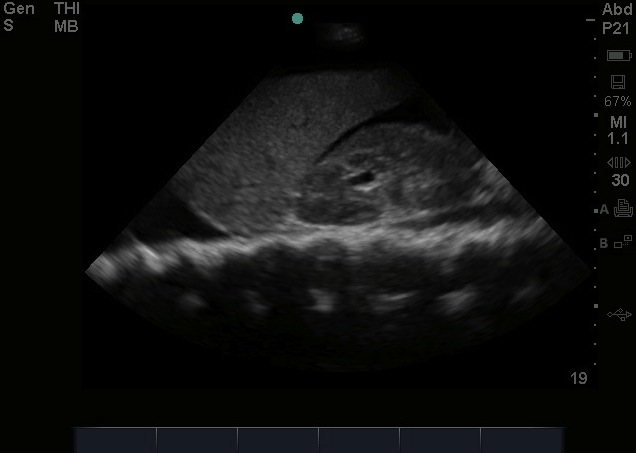
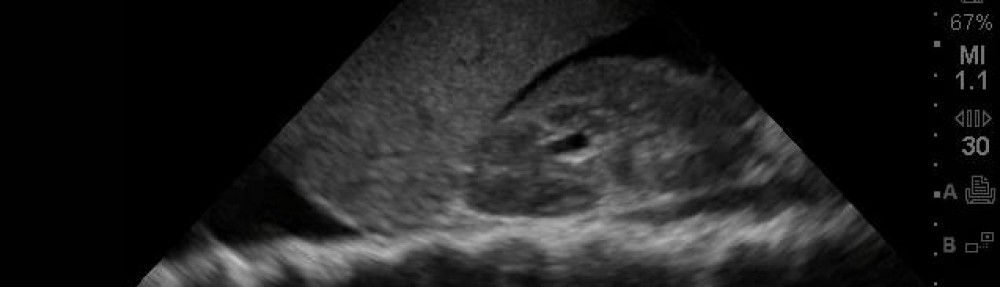
I call it “Da Spine Sign” (insert any accent here – trust me, its funny). So, fluid is the lover of ultrasound, right? And air is the enemy. Typically you will not see the spine passed the diaphragm when looking at your RUQ view for your FAST scan in normal patients, but oh when you do, BAM! You know there’s fluid in the thorax. Here’s an image showing exactly that, as well as a little somethin’ somethin’ in the intraperitoneal space… so, don’t forget to look above the diaphragm in your FAST scan views! By the way – it’s also called the V-Line – I like my name better 🙂