Unknown's avatar

About SonoSpot

US Director Emeritus, Stanford Emergency Medicine Process Improvement Director, Stanford Emergency Medicine Co-Chair, Case Review Committee, Stanford Emergency Medicine

SonoTutorial: The FAST Part 2b: Left Upper Quadrant – More images that could fool you…

Get ready for some more real cases and, just like the prior post, with images of various sections of the left upper quadrant (as you cannot really have all sections in only one 6 second clip). Just like before, think of what is needed to complete the left upper quadrant view:  read the clinical correlate, see the image, and think about what section of the left upper quadrant view is missing (above the diaphragm, below the diaphragm, between the spleen and superior pole of kidney, between the spleen and inferior pole of kidney, or the paracolic gutter), how the image could be improved, and what the interpretation would be. All are stated below the image as well as the actual diagnosis of that particular patient. And, in case any of the below cases stump you as to why the FAST is negative or why it was done in the first place, recall its indications and…. Don’t forget the FAST limitations. Continue reading

SonoStudy: The “ICU-sound” Protocol – Ultrasound revealed unsuspected clinical anomalies, changed management

You have to love the Italians! They are one of the best users and researchers of bedside ultrasound, particularly in the emergency department and ICUs. This was the newest study in the journal of Anesthesiology. In a prior post, we discussed how bedside ultrasound of the heart and IVC changed medical management of septic patients, and the studies just keep on coming….

Medscape has done a nice interview and assessment of this study as well: “Head-to-toe bedside ultrasound within 12 hours of intensive care unit (ICU) admission modified the admitting diagnosis in more than one quarter of the patients studied and confirmed it in more than half of the patients studied” Continue reading

SonoNews: Medicare adds Iatrogenic Pneumothorax to list of hospital acquired conditions!

What does that mean? If a pneumothorax results from that central line attempt or that thoracentesis and any other procedures with this complication, Medicare will not reimburse for it. In the new issue of SonoSite news, it discusses this and how the tool that could prevent pneumothorax from occurring, if used during your procedures, is the exact tool that is best to diagnose at bedside. How ironic is that?!

“Effective October 1, 2012: If, during the performance of a venous catheterization procedure, the clinician accidentally causes a pneumothorax, Medicare will no longer reimburse the hospital for the extra costs of a resulting pneumothorax (collapsed lung) complication. Continue reading

SonoPearls… from Stanford Bedside Ultrasound Course… for FAST, Echo and RUSH

Teaching US with fellow US lovers is just too fun. What I appreciated most – multi-specialty!! …

…with Sarah Williams (EM), me (EM), Zoe Howard (EM), Brie Zaia (EM), Darrel Sutijono (EM), Phil Perera (EM/IM), Yoshi Mitarai (EM-ICU), MyPhuong Mitarai (EM), Viveta Lobo (EM), Anne-Sophie Beraud (Cards), John Kugler (IM):

Multi-dept instructors: EM, IntMed, ICU, Cards.
Multi-dept learners: Anesth, IntMed, Peds, Surg, EM, NPs

US Pearls: Continue reading

SonoTutorial: The FAST Part 2a: Left Upper Quadrant – Images that could fool you…

Get ready for some cases!!! The images and clips below will be a great review to see how much of the information from the prior post on how to perform a complete left upper quadrant view of the FAST scan you recall, while keeping FAST limitations in mind. Remember, in order to be complete and thorough you must evaluate above the diaphragm, below the diaphragm, around the spleen and superior pole of the kidney, and around the spleen and inferior pole of the kidney, and along the left paracolic gutter –  through slow, deliberate, and full fanning between multiple rib spaces, and adjusting your depth as needed.

The images will appear with a clinical correlation first which may give you a certain level of suspicion. Think about what part of the LUQ scan is missing (as there is very few times when you can get all of the above areas in just one clip or in just one rib space), how would you improve the evaluation (changing position of probe, fan more widely or slowly, depth or gain (brightness) adjustment, etc), and what your interpretation of that image would be (positive or negative for free fluid – or is the image just too technically limited to make a statement on it?)- all while thinking of your level of suspicion of injury given the clinical correlate.

These are all real cases: Continue reading

SonoTutorial: The FAST Part 2: Left Upper Quadrant – being right with the left…

No, this isnt a talk about partisan politics (thankfully!), but something that is even more important that you should know and learn well, that could not only change everyone’s life [like politics thinks it does] (by way of how they manage their patients) but also saves a life (by how quickly you help your diagnoses be made). That’s right fellow blogosphere friends. Listen up!

Our SonoTutorial on The FAST: Right Upper Quadrant (RUQ) week was just the beginning of this review on the FAST scan- the most common application done at the bedside at many institutions, and for good reason. It’s used (as a screening study for intraperitoneal free fluid) for any blunt or penetrating chest/abdomen/back trauma as well as the unexplained hypotensive patient (the RUSH exam). The RUQ is the best area to evaluate for free intraperitoneal fluid of all the FAST views, but don’t think you can just do that view and stop there! It is not 100%, and there are enough times for me to see free fluid in the left upper quadrant (LUQ) that was difficult to see in the RUQ that makes it evident that completing the FAST scan is key! The LUQ is, essentially, the not-so-ugly sister to the RUQ. Continue reading

SonoStudy: Many emergency physicians feel uncomfortable with US-guided central venous access

In the an issue of West JEM, Backlund et al did a survey study of emergency physicians in Colorado with 116 responses asking questions about their use (or lack thereof) bedside ultrasound for central venous access. Quite a few, too many actually, feel uncomfortable using ultrasound for central venous access. 97% of them have ultrasound machines in their department, so it’s not because of a lack of equipment. 77% agree with the statement:”Ultrasound guidance is the preferred method for central venous catheter placement in the emergency department.”  So what was it? Well, it’s always the easiest and most obvious answer: their lack of training and, therefore, a lack of comfort level. “47% cite lack of training in UGCVC as a barrier to performing the technique.”

Continue reading

SonoTip&Trick: “I can’t get a good RUQ view for my FAST!” – Really? Well, try this…

The “F” in FAST does not mean “fast”; it stands for “focused”. The good thing is that everyone agrees to that, but we so often forget. This week has turned into the right upper quadrant (RUQ) view of the FAST week! I actually don’t mind that at all and I love it – as too many incomplete FAST scans are done (and accepted). It’s tragic, actually. I get it, and I’ve been there – you feel rushed because you either have too many patients to see, others need the ultrasound machine, or your consultants or surgeons are yelling at you to hurry up because they want to roll the patient or get that life-saving chest radiograph (don’t get me started!). It needs to be a complete, deliberate, and dedicated study. You should know when and how to do the FAST, especially the RUQ as it is one of the most accurate, and how to do it well. After having shown you several cases and images of real patients, some (including me) still have a hard time getting the perfect views of each of the sections of the RUQ (yes, there are “sections” of the RUQ) even though everything is done the right way. Well, thankfully, there are some little tricks to improve your image quality  – so that you feel confident about telling that consultant the FAST results with your voice confident, back straight, chest out and shoulders back. You may even want to add a “booya” at the end of it. Continue reading

SonoTutorial: The FAST Part 1b: The Right Upper Quadrant: More images that could fool you

Get ready for some more real cases and, just like the prior post, with images of various sections of the right upper quadrant (as you cannot really have all sections in only one 6 second clip). Just like before, think of what is needed to complete the right upper quadrant view:  read the clinical correlate, see the image, and think about what section of the right upper quadrant view is missing (above the diaphragm, below the diaphragm, between the liver and superior pole of kidney, between the left heptaic edge and inferior pole of kidney at the paracolic gutter), how the image could be improved, and what the interpretation would be. All are stated below the image as well as the actual diagnosis of that particular patient. And, in case any of the below cases stump you as to why the FAST is negative or why it was done in the first place, recall  it’s indications and…. Don’t forget the FAST limitations. Continue reading

SonoTutorial: The FAST Part 1a: The Right Upper Quadrant: Images That Could Fool You

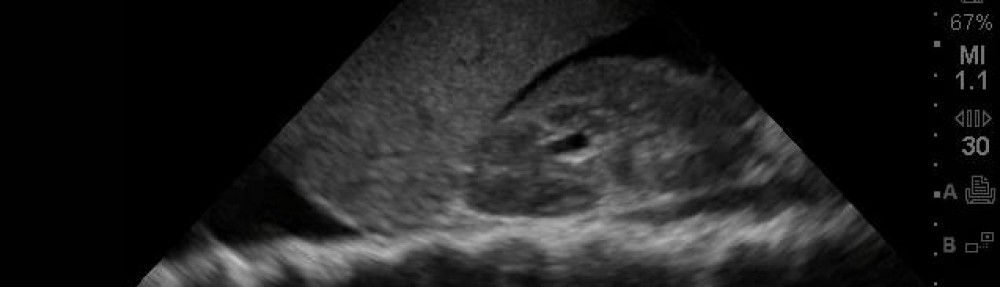
Now the fun starts! The images and clips below will be a great test to see how much of the information from the prior post on how to perform a complete right upper quadrant view of the FAST scan you recall, while keeping it’s limitations in mind. Remember, to be complete and thorough, you must evaluate above the diaphragm, below the diaphragm, around the liver and superior pole of the kidney, and around the left liver edge and inferior pole of the kidney (along the right paracolic gutter) through slow and deliberate full fanning between multiple rib spaces, and adjusting your depth as needed.

Continue reading