Unknown's avatar

About SonoSpot

US Director Emeritus, Stanford Emergency Medicine Process Improvement Director, Stanford Emergency Medicine Co-Chair, Case Review Committee, Stanford Emergency Medicine

SonoStudy: US-guided lines by nurses (& docs) reduce need for physician intervention (& central lines!) for difficult access

A recent study, from the Journal of Emergency Medicine, by Weiner et al at Tufts University, in addition to so many of the prior studies, proves that nurses SHOULD perform ultrasound guided peripheral line placement. they are good at it, they do it right, and they do it well. Oh, and patients love it.

“Emergency physicians (EPs) have become facile with ultrasound-guided intravenous line (USIV) placement in patients for whom access is difficult to achieve, though the procedure can distract the EP from other patient care activities…..A prospective multicenter pilot study: Interested emergency nurses (ENs) received a 2-h tutorial from an experienced EP. Patients were eligible for inclusion if they had either two failed blind peripheral intravenous (i.v.) attempts, or if they reported or had a known history of difficult i.v. placement. Consenting patients were assigned to have either EN USIV placement or standard of care (SOC).” 50 patients enrolled, 29 assigned to USIV and 21 to SOC. “Physicians were called to assist in 11/21 (52.4%) of SOC cases and 7/29 (24.1%) of USIV cases (p = 0.04). Patient satisfaction was higher in the USIV group, though the difference did not reach statistical significance (USIV 86.2% vs. SOC 63.2%, p = 0.06). ”

And, even more recently, another study:

Ultrasound-Guided Peripheral Intravenous Access Program Is Associated With a Marked Reduction in Central Venous Catheter Use in Noncritically Ill Emergency Department Patients.

by Shokoohi et al from George Washington University published in the Annals of Emergency Medicine has been getting quite a bit of press – particularly from MedwireNews: “Training emergency department (ED) staff in use of ultrasound to guide difficult peripheral intravenous catheter placement appears to reduce the unnecessary use of central venous lines, a study suggests. The reduction in central venous line use after the introduction of ultrasound training was particularly notable for patients who were not critically ill, report Hamid Shokoohi (George Washington University, DC, USA) and colleagues…..They say that this has “potentially major implications for patient safety,” noting that around 15% of the 5 million central venous catheters placed in the USA annually result in complications, which can include blood infections, thrombosis, vessel damage, and hematomas.”

The study itself was: “….a time-series analysis of the monthly central venous catheter rate among adult emergency department (ED) patients in an academic urban ED between 2006 and 2011. During this period, emergency medicine residents and ED technicians were trained in ultrasound-guided peripheral intravenous access. We calculated the monthly central venous catheter placement rate overall and compared the central venous catheter reduction rate associated with the ultrasound-guided peripheral intravenous access program between noncritically ill patients and patients admitted to critical care. Patients receiving central venous catheters were classified as noncritically ill if admitted to telemetry or medical/surgical floor or discharged home from the ED. RESULTS: During the study period, the ED treated a total of 401,532 patients, of whom 1,583 (0.39%) received a central venous catheter. The central venous catheter rate decreased by 80% between 2006 (0.81%) and 2011 (0.16%). The decrease in the rate was significantly greater among noncritically ill patients (mean for telemetry patients 4.4% per month [95% confidence interval {CI} 3.6% to 5.1%], floor patients 4.8% [95% CI 4.2% to 5.3%], and discharged patients 7.6% [95% CI 6.2% to 9.1%]) than critically ill patients (0.9%; 95% CI 0.6% to 1.2%). The proportion of central venous catheters that were placed in critically ill patients increased from 34% in 2006 to 81% in 2011 because fewer central venous catheterizations were performed in noncritically ill patients. CONCLUSION: The ultrasound-guided peripheral intravenous access program was associated with reductions in central venous catheter placement, particularly in noncritically ill patients. Further research is needed to determine the extent to which such access can replace central venous catheter placement in ED patients with difficult vascular access.”

A great video on the scanning technique and choosing the right vein can be found here by SonoSite and taught by my good friend, Diku Mandavia:

Another great how-to video can be found here: although long, its a good one for a step-by-step, from the New England Journal of Medicine:
SonoStudy: Emergency Physician-Performed Ultrasound for DVT – a systematic review and meta-analysis

A recent study has made me so excited that I hope it has the Nay-sayers out there ponder and become believers!

“Duplex ultrasound is the first-line diagnostic test for detecting lower limb deep-vein thrombosis (DVT) but it is time consuming, requires patient transport, and cannot be interpreted by most physicians. The accuracy of emergency physician-performed ultrasound (EPPU) for the diagnosis of DVT, when performed at the bedside, is unclear. We did a systematic review and meta-analysis of the literature, aiming to provide reliable data on the accuracy of EPPU in the diagnosis of DVT. The MEDLINE and EMBASE databases (up to August 2012) were systematically searched for studies evaluating the accuracy of EPPU compared to either colour-flow duplex ultrasound performed by a radiology department or vascular laboratory, or to angiography, in the diagnosis of DVT. Weighted mean sensitivity and specificity and associated 95% confidence intervals (CIs) were calculated using a bivariate random-effects regression approach. There were 16 studies included, with 2,379 patients. The pooled prevalence of DVT was 23.1% (498 in 2,379 patients), ranging from 7.4% to 47.3%.

Using the bivariate approach, the weighted mean sensitivity of EPPU compared to the reference imaging test was 96.1% (95%CI 90.6-98.5%), and with a weighted mean specificity of 96.8% (95%CI:94.6-98.1%). Our findings suggest that EPPU may be useful in the management of patients with suspected DVT. Future prospective studies are warranted to confirm these findings.”

That’s right, you read it correctly – EPPU is ok to do and can be useful in the evaluation for DVT – but, of course, it takes studies for people to believe us. Using the two-point compression technique at 2 sites: femoral and popliteal  – identify the vein (its the one next to the artery), compress the vein at 1 cm intervals for at least 5 cm length. A noncompressible vein is positive for DVT. Echogenicity, augmentation are proven to not increase your findings of a DVT, and therefore are not needed. Simply compress.

Here is a great 5 minute review of the DVT Ultrasound technique by SonoSite:

SonoNews: Chest ultrasound for acute dyspnea used by internal medicine…yes!

In a recent publication through Medscape, they site a research article and presentation at the American College of Chest Physicians – in Chest Oct 2012  – stating “With minimal training, internal medicine house staff can successfully use hand-held ultrasound devices in the diagnosis of acute dyspnea.” This is huge! Why? Well, where do I begin? First off, lung ultrasound is advancing like never before – not that it wasn’t already known it was awesome for pneumothorax, pleural effusion, and pulmonary edema, but now the evaluation for pneumonia has gotten a lot of press. Secondly, you have more studies coming out that with minimal training, lung ultrasound can be used by physicians to help diagnose the cause for shortness of breath, which is great and helps get the fear of looking out of the conversation. FInally, and more exciting to me than anything above, is that bedside ultrasound is spreading!!! – to internal medicine (in this posting), but also to involve surgical clinics, sports medicine, pediatrics, and ophthalmologists  – – using bedside ultrasound to aid in their evaluation of their patients.

The article describes: “Ravindra Rajmane, MD, from the New York University Langone Medical Center in New York City, and colleagues reported the study findings in a poster presentation here at CHEST 2012: American College of Chest Physicians Annual Meeting. “The technology of sonography has improved markedly over the past few years,” Dr. Rajmane told Medscape Medical News. “Our study underscores the ease of transporting and effectively applying this technology with minimal training,” she said. “Our residents were able to successfully learn the basics of lung ultrasonography with a 1-hour didactic lecture followed by 1 hour of hands-on training. Unstructured training was also provided during ICU [intensive care unit] rounds.” According to the researchers, acute dyspnea is normally assessed with a combination of history taking, physical examination, electrocardiography, chest x-ray, and lab work. Lung ultrasound is increasingly being used to assess acute respiratory conditions because it is faster, less invasive, and more sensitive.” – Hallelujiah!!!

Keep it spreadin….

Even the OBGYN doctors are learning to use lung ultrasound in evaluating shortness of breath in pregnant patients!

A prior case that evaluated a patient who came in with shock and shortness of breath illustrates a way lung ultrasound can be used to help evaluate, diagnose, and work up your patient and can be find here.

SonoPearl – Look at the ENTIRE screen when evaluating an organ… a case by Dr. Teresa Wu and Brady Pregerson

In the most recent issue of EPMonthly, our good friend, Dr. Teresa Wu, and Brady Pregerson right up a case they had of a patient with abdominal pain. In their wisest and most sarcastic way, they present this case with a great teaching point (ok, there are many teaching points as you will find on the last page of the case – but one in particular that deserves special mention). Read on and see if you can get what that point may be…

“56-year-old otherwise healthy female who presented to the ED with a chief complaint of “severe abdominal pain” after she finished lifting boxes of heavy books at her job the day before. She states her pain is worse with movement and is better when she lies still. She has never had pain like this before, and today, it is 10 out of 10 in severity. The pain is described as sharp and tearing, but it does not radiate to her chest or back. She has no other associated symptoms, and she has tried Ibuprofen without any relief.

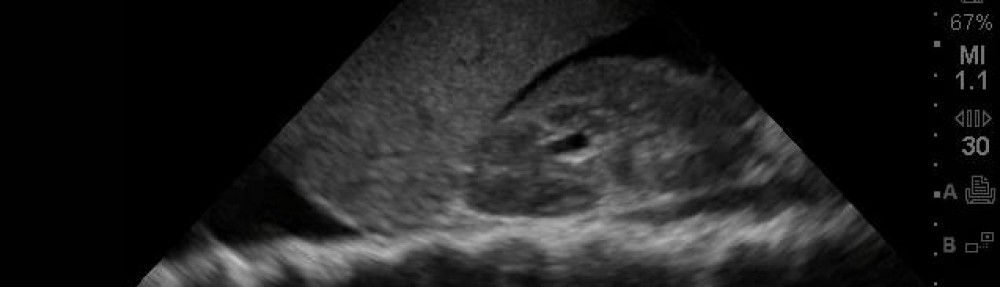
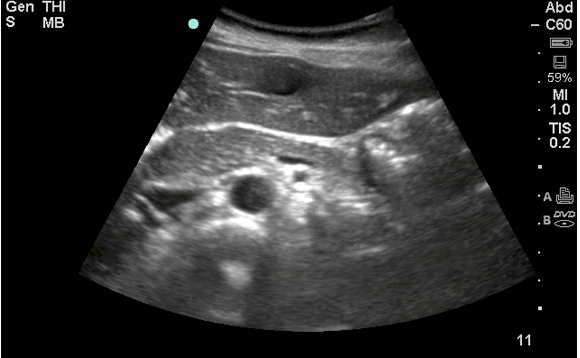
Her vital signs are all completely within normal limits and her physical exam is only remarkable for tenderness to palpation over her left rectus muscles, and a seemingly pulsatile aorta palpable through her thin abdominal wall. She has no rebound or guarding on abdominal exam, and she has no other abnormal findings. Given her symptoms and her palpable aorta, your senior resident decides it would be prudent to do a quick scan of her aorta to make sure nothing catastrophic is imminent.” The following image was obtained:”

The Aorta seems ok. Hmmmm…..Still wonder what happened to the case and what it was? Read the issue in depth and you’ll then get to know and love Teresa Wu as much as I do.

Hint – look at the entire screen when evaluating any organ by bedside ultrasound…..

SonoPolitics: Bedside Ultrasound is NOT an extension of the physical exam – it’s much more

Ok, get ready for another rant….. I know, I just keep ’em comin’, but this needs to be discussed. I know you’ve heard it before: “Ultrasound is an extension of the physical exam.” I heard it before too – when I was first learning it, when someone was trying to explain it’s use in patient care. But, the fact of the matter is, it’s so much more. Just because it’s in the bedside clinicians’ hands, and not a radiologists hands, doesn’t mean it’s not an equally important diagnostic tool. More than that, its a tool used when procedures are performed that has proven to minimize complications and thus affecting patient safety. It answers the questions that even the best and most complete physical exam (which is unfortunately hardly ever done) cannot.

ACEP 2012 in Denver, CO was amazing…. and I still plan to post all that I learned from that conference, but one of the statements that were said in the Emergency US management course that is so clear to me yet seems to be hard to grasp by others is that “Ultrasound is NOT an extension of the physical exam, so stop saying it is. It answers clinical questions.”  – Now, when I heard from my friend who attended the course that this was said, I knew it already, and it makes complete sense to me, but, interestingly, it appeared that those conducting the course felt it important enough to state it clearly and concisely – as they heard this statement spreading, needing clarification. It was apparently spoken about by basically every leader in bedside ultrasound before, during, and after the course.

Ok, let’s talk about this. The physical exam is an evaluation of the patient; a use of ultrasound is to evaluate the patient – there is a difference. A physician will perform their history and physical exam, then think of what is needed for diagnosis, work up, management, and treatment. Sometimes, but not all the time, that involves bedside ultrasound (just like any other imaging modality that is chosen to be ordered to work up a patient, except it will be a focused study). Ultrasound CAN extend the physical exam, but Ultrasound is a diagnostic tool; Ultrasound is used for procedural guidance; Ultrasound is an expensive machine that is used as a procedure in overcoming physical exam limitations (like a chest XRay done to evaluate whether the crackles you hear on your physical exam is pneumonia or an effusion). It does answer clinical questions. Why this matters, and why am I going on this rant? Well, one reason is that the statement “ultrasound is an extension of the physical exam” is a simple statement that gets a lot of attention but it’s not complete, and some would argue that it’s just plain wrong, for the reasons stated above, but allow me to explain further. It is true that soon after the physical exam, a bedside ultrasound can be performed after an indication presents itself, but just because it’s temporally related or performed by the same physician who does the history and physical exam, doesn’t mean it’s an extension of it. It’s a focused study to answer a clinical question, answers that cannot be obtained by the physical exam (instead of the chest Xray, using ultrasound to differentiate pneumonia from effusion). Is an IV line or lab test an extension of the physical exam (which is sometimes performed at the same time as the history and physical, and sometimes by the physician when the nurse or phlebotomist is unavailable or the nurse is unable to get the IV)? Is an echo done by a cardiologist right after they performed a history and physical exam an extension of their physical exam? Is an ultrasound performed to evaluate the fetus of a pregnant mother by the same OBGYN doctor who just performed the physical exam an extension of the physical exam? Is a CT scan an extension of the physical exam (which can be ordered right after the physical exam)? No. Another important reason is that if it was considered by us physicians simply as an extension of the physical exam, then the risk of eliminating reimbursement from insurance companies for performing this procedure, this important diagnostic and procedural tool, exists. If the physician is using it as an extension of the physical exam, you cannot bill for it because it is an extension of the Evaluation and Management (E/M) examination. If a physican is using it for an accepted medical necessity for diagnostic or procedural purposes with appropriate documentation and image archiving abilities (which I would argue is the way we should be using it), then we can bill for it (however small that charge actually is, but let’s not go there), giving us the funds to purchase more machines and hire more ultrasound-savvy physicians to teach others who will then use this tool to ultimately save a life…..

I do get why some people say it to others: it sounds good, minimizes the fear of learning it, makes it sound easy, and is encouraging to others to believe in its utility. The intent is good. But, it’s just not enough – it’s not an extension of the physical exam, but it is an amazing imaging tool that diagnoses, helps manage, and minimizes complications of procedures of patients.

Ultrasound does not, and should not, replace the physical exam. “There is a natural synergy between the physical exam and the ultrasound machine. They should not be enemies, but instead should be allies. It can extend your evaluation of the patient, and add to your physical exam. But, it is also a diagnostic tool that is equivalent to a standard ultrasound. When it only was used for a few applications, it was thought to be an extension of the physical exam, but now with all that we know about it, it’s not simply an extension of the physical exam, it is much more.” – Dr. Michael Blaivas to the World Congress of Ultrasound in Medical Education.

SonoReview & Case: Acute pelvic pain by ultrasound, 1st trimester evaluation, and what to do when “Coming up Empty”…

In the most recent installment of the Sound Judgement Series by AIUM, Drs. Rochelle F. Andreotti and Sara M. Harvey from the Department of Radiology at Vanderbilt discuss the use, accuracy and effectiveness of ultrasound for acute pelvic pain. It seems that pelvic pain has, again, become an important issue as there are quite a few articles that have come out about it recently, likely because there are so many visits to clinics and emergency departments with this exact chief complaint. As the authors state “The diagnosis can be challenging because many symptoms and signs lack sensitivity and specificity. Urgent life-threatening conditions requiring surgical intervention (eg, ectopic pregnancy, appendicitis, a ruptured ovarian cyst, and ovarian torsion) and fertility-threatening conditions (eg, pelvic inflammatory disease [PID] and ovarian torsion) should take precedence over other disorders.” – Guess which imaging modality can evaluate all of them? Continue reading

SonoUse – When it actually matters….

I decided to post about a case that did not happen while I was on shift, or while any of my residents or students were on shift, but while I was sitting at the bedside of my family member who was in their regional emergency department…..ok, I’ll start out by admitting that this post is biased – to the extent that I want the best for my family and expect that all available resources be utilized for them, as well as being biased toward the use of the bedside technical God (aka ultrasound machine, if that wasn’t obvious) that answers the questions I need answered quickly – when it counts. I recently commented on a post from the LITFL “Ultrasound Training Rant” about this case, and it deserves mention again. I couldnt agree more with the point that the physician has to be able to “inspect, palpate, percuss, auscultate, ultrasound and cogitate….” — and I wish they would do them all correctly. Continue reading

SonoCaseReport: Free fluid on FAST not always at Morrison’s Pouch in RUQ view….

An article that just recently came to my attention made me start to think a little bit about how we teach how to do the FAST scan. In a prior post, I discuss the RUQ and LUQ details – to ensure to not miss any amount of free fluid that should be seen on the FAST scan, keeping in mind it’s limitations. Then, I read this article in the EMJ online First from April 2012 that discusses a case of an ‘unusually’ positive FAST scan, but when reading about the injury and the location, I am not surprised about the location of free fluid development. Hind-sight is 20/20, but it highlights a few key concepts that should always be addressed: look for free fluid in the REGION on the RUQ and LUQ, not only between the liver/spleen and kidneys AND serial FAST scans for any patient where the mechanism suggests a risk for intra-abdominal injury (particularly if you are not going to CT the patient) – I do this frequently in the patients who come in drunk as all get-out where I cannot rely on my physical exam or the pediatric population where radiation would be best avoided if possible.

The case from the article: Continue reading

SonoArticle: Ultrasound FIRST for cellulitis/abscess evaluation – by Adhikari & Blaivas, oh yeah!

In a prior post we discussed the concept of what is now one of the post popular phrases that have come to be used as a Sono-term: ‘pus-stalsis’. Yup, that’s right  – the movement of pus seen with compression over the area of hypoechogenicity when using the linear probe to evaluate for fluid filled pocket that’s concerning for abscess. It can fool you! Instead of doing a needle aspiration – take a look! push down on it and see if there is pus-stalsis! It’s easy. Continue reading

SonoParty…&Journal Club… in Northern CA: Stanford, UCSF, UCSF/Fresno, UC Davis, Highland, Kaisers

Prior to leaving for ACEP in Denver, CO there was a gathering (aka “party”) at my home in sunny San Francisco with my friends and colleagues in emergency medicine / emergency ultrasound  – from all of the ultrasound programs in the region – it was amazing… and yes, wine was served! … along with pizza (of course!) We discussed 4 articles as listed below and I took down the US pearls noted from the various physicians who attended: Continue reading