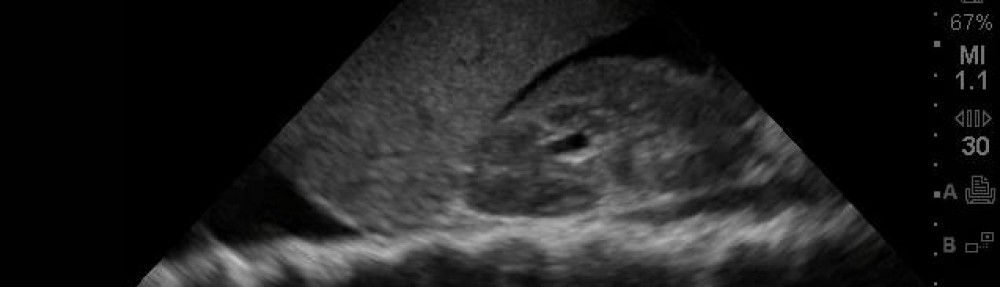
SonoPearl – Look at the ENTIRE screen when evaluating an organ… a case by Dr. Teresa Wu and Brady Pregerson

In the most recent issue of EPMonthly, our good friend, Dr. Teresa Wu, and Brady Pregerson right up a case they had of a patient with abdominal pain. In their wisest and most sarcastic way, they present this case with a great teaching point (ok, there are many teaching points as you will find on the last page of the case – but one in particular that deserves special mention). Read on and see if you can get what that point may be…

“56-year-old otherwise healthy female who presented to the ED with a chief complaint of “severe abdominal pain” after she finished lifting boxes of heavy books at her job the day before. She states her pain is worse with movement and is better when she lies still. She has never had pain like this before, and today, it is 10 out of 10 in severity. The pain is described as sharp and tearing, but it does not radiate to her chest or back. She has no other associated symptoms, and she has tried Ibuprofen without any relief.

Her vital signs are all completely within normal limits and her physical exam is only remarkable for tenderness to palpation over her left rectus muscles, and a seemingly pulsatile aorta palpable through her thin abdominal wall. She has no rebound or guarding on abdominal exam, and she has no other abnormal findings. Given her symptoms and her palpable aorta, your senior resident decides it would be prudent to do a quick scan of her aorta to make sure nothing catastrophic is imminent.” The following image was obtained:”
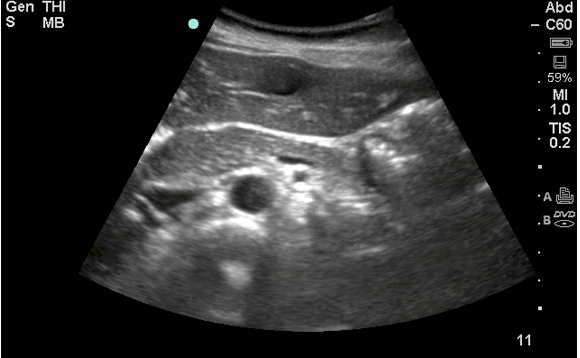
The Aorta seems ok. Hmmmm…..Still wonder what happened to the case and what it was? Read the issue in depth and you’ll then get to know and love Teresa Wu as much as I do.

Hint – look at the entire screen when evaluating any organ by bedside ultrasound…..

SonoReview & Case: Acute pelvic pain by ultrasound, 1st trimester evaluation, and what to do when “Coming up Empty”…

In the most recent installment of the Sound Judgement Series by AIUM, Drs. Rochelle F. Andreotti and Sara M. Harvey from the Department of Radiology at Vanderbilt discuss the use, accuracy and effectiveness of ultrasound for acute pelvic pain. It seems that pelvic pain has, again, become an important issue as there are quite a few articles that have come out about it recently, likely because there are so many visits to clinics and emergency departments with this exact chief complaint. As the authors state “The diagnosis can be challenging because many symptoms and signs lack sensitivity and specificity. Urgent life-threatening conditions requiring surgical intervention (eg, ectopic pregnancy, appendicitis, a ruptured ovarian cyst, and ovarian torsion) and fertility-threatening conditions (eg, pelvic inflammatory disease [PID] and ovarian torsion) should take precedence over other disorders.” – Guess which imaging modality can evaluate all of them? Continue reading

SonoUse – When it actually matters….

I decided to post about a case that did not happen while I was on shift, or while any of my residents or students were on shift, but while I was sitting at the bedside of my family member who was in their regional emergency department…..ok, I’ll start out by admitting that this post is biased – to the extent that I want the best for my family and expect that all available resources be utilized for them, as well as being biased toward the use of the bedside technical God (aka ultrasound machine, if that wasn’t obvious) that answers the questions I need answered quickly – when it counts. I recently commented on a post from the LITFL “Ultrasound Training Rant” about this case, and it deserves mention again. I couldnt agree more with the point that the physician has to be able to “inspect, palpate, percuss, auscultate, ultrasound and cogitate….” — and I wish they would do them all correctly. Continue reading

SonoCaseReport: Free fluid on FAST not always at Morrison’s Pouch in RUQ view….

An article that just recently came to my attention made me start to think a little bit about how we teach how to do the FAST scan. In a prior post, I discuss the RUQ and LUQ details – to ensure to not miss any amount of free fluid that should be seen on the FAST scan, keeping in mind it’s limitations. Then, I read this article in the EMJ online First from April 2012 that discusses a case of an ‘unusually’ positive FAST scan, but when reading about the injury and the location, I am not surprised about the location of free fluid development. Hind-sight is 20/20, but it highlights a few key concepts that should always be addressed: look for free fluid in the REGION on the RUQ and LUQ, not only between the liver/spleen and kidneys AND serial FAST scans for any patient where the mechanism suggests a risk for intra-abdominal injury (particularly if you are not going to CT the patient) – I do this frequently in the patients who come in drunk as all get-out where I cannot rely on my physical exam or the pediatric population where radiation would be best avoided if possible.

The case from the article: Continue reading

SonoParty…&Journal Club… in Northern CA: Stanford, UCSF, UCSF/Fresno, UC Davis, Highland, Kaisers

Prior to leaving for ACEP in Denver, CO there was a gathering (aka “party”) at my home in sunny San Francisco with my friends and colleagues in emergency medicine / emergency ultrasound  – from all of the ultrasound programs in the region – it was amazing… and yes, wine was served! … along with pizza (of course!) We discussed 4 articles as listed below and I took down the US pearls noted from the various physicians who attended: Continue reading

SonoNews: Medicare adds Iatrogenic Pneumothorax to list of hospital acquired conditions!

What does that mean? If a pneumothorax results from that central line attempt or that thoracentesis and any other procedures with this complication, Medicare will not reimburse for it. In the new issue of SonoSite news, it discusses this and how the tool that could prevent pneumothorax from occurring, if used during your procedures, is the exact tool that is best to diagnose at bedside. How ironic is that?!

“Effective October 1, 2012: If, during the performance of a venous catheterization procedure, the clinician accidentally causes a pneumothorax, Medicare will no longer reimburse the hospital for the extra costs of a resulting pneumothorax (collapsed lung) complication. Continue reading

SonoPearls… from Stanford Bedside Ultrasound Course… for FAST, Echo and RUSH

Teaching US with fellow US lovers is just too fun. What I appreciated most – multi-specialty!! …

…with Sarah Williams (EM), me (EM), Zoe Howard (EM), Brie Zaia (EM), Darrel Sutijono (EM), Phil Perera (EM/IM), Yoshi Mitarai (EM-ICU), MyPhuong Mitarai (EM), Viveta Lobo (EM), Anne-Sophie Beraud (Cards), John Kugler (IM):

Multi-dept instructors: EM, IntMed, ICU, Cards.
Multi-dept learners: Anesth, IntMed, Peds, Surg, EM, NPs

US Pearls: Continue reading

SonoTutorial: The FAST Part 1a: The Right Upper Quadrant: Images That Could Fool You

Now the fun starts! The images and clips below will be a great test to see how much of the information from the prior post on how to perform a complete right upper quadrant view of the FAST scan you recall, while keeping it’s limitations in mind. Remember, to be complete and thorough, you must evaluate above the diaphragm, below the diaphragm, around the liver and superior pole of the kidney, and around the left liver edge and inferior pole of the kidney (along the right paracolic gutter) through slow and deliberate full fanning between multiple rib spaces, and adjusting your depth as needed.

Continue reading

SonoTutorial: The FAST Part 1: The right upper quadrant – the right way to do it

The FAST scan (focused assessment with sonography for trauma) is probably the most frequent application of bedside ultrasound with a moderate sensitivity and very high specificity. It is done as part of our trauma evaluation for blunt or penetrating chest/abdomen/back/pelvic trauma as well as in the evaluation of the unexplained hypotensive patient as part of the RUSH protocol and the patient with a possible ruptured ectopic pregnancy.

Continue reading

SonoStudy: False negative FAST scans: association with patient characteristics/injuries/outcomes?

A study recently published in Annals of Emergency Medicine by Laselle et al attempt to estimate associations between false negative FAST results and patient characteristics, specific organ injuries, and patient outcomes by doing a retrospective analysis of consecutive patients who had a blunt abdominal trauma with pathologic free fluid found by CT, DPL (yeah, I know, weird), laparotomy, or autopsy (ouch!). Over 300 enrolled and 162 had a false negative FAST scan. Continue reading