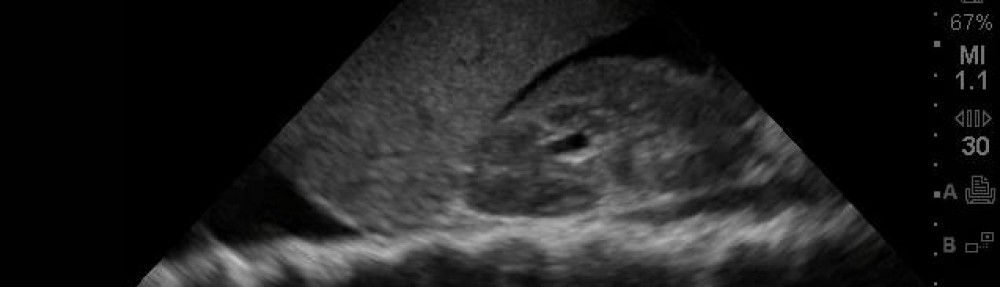
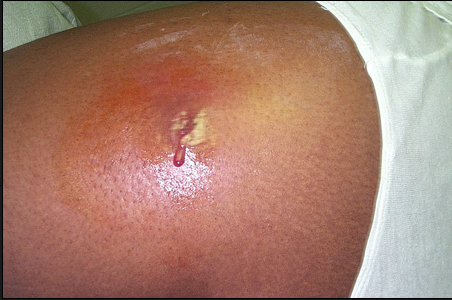
SonoApp & Study: Cellulitis vs Abscess; US more sensitive than CT for soft tissue abscess

A patient comes into your emergency department or outpatient clinic that has a painful red area on their skin:

 -from Medicineo blog

…and you wonder whether its a superficial cellulitis, or if it’s a pus-filled abscess – and if it is an abscess, then how deep is it? how long is it? how loculated is it? Continue reading

SonoApp/News: “The window to the soul!” Intracranial Pressure by Ocular Ultrasound

One day, years ago, I went to my ophthalmologist who looked in my eye through their ‘whatchamacallit’-scope and then sat back in his chair and asked me (with a straight face): “Are you having any diarrhea?” Of course, this immediately confused me as I wondered whether my years of medical training lacked the concept that my eye could assess diarrhea. I answered with a chuckling, “no” and he concluded with, “ok, then Im sure it’s fine.” I decided to just forget that odd encounter until I started to perform ocular ultrasounds several years ago, excited about how I now dont have to rely on my horrible fundoscopic technique as it gives tons of information not only about the eye, but also the brain! Continue reading

SonoInterview by Medscape: A Radiologist’s perspective of Appendix US…replacing CT? Yes!

This comes in great timing as a prior SonoSpot post describing recent studies evaluating CT findings in appendicitis rule-outs show that the majority ( 80-90% ) are negative…. US, clinical judgement, and a possible observation period can go a long way in radiation reduction.

Expert Interview: Stephanie Wilson, MD, on the Value of Ultrasonography for Imaging Appendicitis

Continue reading

SonoReview: US-guided Interscalene nerve blocks

Hope you had a Happy 4th! To all those who received patients with an upper extremity that has been burned, fractured, or blown away from all the “legal” fireworks foreplay……

Pain control. Two words. Patient satisfaction. Two more words. Physician satisfaction. Two MORE words. Nerve blocks are the new procedural sedation for many painful procedures we do in the ED. Takes much less resources and time, and provides immediate pain control for however long your anesthetic will work without concern for respiratory distress, hypotension, hypoxia, and… well… death. So why dont we do it more? Well, in a prior post, we have discussed the ins & outs for performing US guided nerve blocks with the help of some of my colleagues, some of whom are mentioned below.

Continue reading

SonoApp: Lung Ultrasound… Be fine with B lines!

So you get a patient with shortness of breath, and you have no idea what the reason is…. but they can’t lie flat and the Xray tech is busy with the trauma. Lung US can help you – but that’s weird, right? Air is supposed to be the enemy of ultrasound with gas scatter artifact making what you want to see very hard. Well, believe it or not, with the lung, ultrasound will turn into your go-to tool for quick evaluation. There has been a study that has described a methodical approach to this, the RADIUS study, and one of the key elements of this is evaluating artifact. Yup, that’s right, ARTIFACT…. Continue reading

SonoApp: Lung Ultrasound – The down low of pneumo…with the help of Lichtenstein, of course

Lung ultrasound (aka thoracic US) is one of the currently most popular applications of bedside ultrasound. It was found to be more sensitive and specific than chest XRay for pleural effusion, pulmonary edema, and pneumothorax evaluation (see meta-analysis in Chest here)…. how about them apples?! There have been some recent studies suggesting that in the heat of the moment for trauma patients, the sensitivity may be slightly lower than other studies state, but it is still better than chest Xray! Not only does it take a long time to get that chest Xray done in your ED or in through your ambulatory care practice, but its more expensive than bedside limited ultrasound for the patient as well…. lets not even talk about the radiation (yes, I know, Chest Xray radiation is minimal, but it’s still radiation). The evaluation of the lungs takes no more than 3 minutes, and ultrasound machines can be found in your pocket now (should you want that kind of VERY COOL technology). US machines can also be the size of a laptop with better resolution and multiple probe capabilities – so, needless to say, its easy, portable, fast, and more accurate. Now let’s talk… Continue reading

SonoCase: 45 yr old female acute respiratory distress…. RUSH, part deux

Here’s another crazy case I had in the middle of the night in the ED, a night that was particularly… let’s say… challenging. Lots of patients (about 43 actually) and 2 thankfully great residents, and one other ED attending. We were busy supervising a chest tube placement, while overseeing the trauma next door and finishing our charts on other patients so they can be dispo’d (yup, multi-tasking at its best – [or worst, ya never know]) and we get a ring down of a 45 year old in acute respiratory distress placed on non-rebreather with subsequent vitals:  HR 130s   BP 80s/50    RR 38     90%O2 sat. Continue reading

SonoCase: 78 yr old, hypotensive, altered…Welcome to “RUSH” week!

Yup, that’s right, we are going to go through the RUSH exam this week. Its “RUSH” WEEK!!!! To all those in SonoSororities and SonoFraternities out there, this week is going to be dedicated to “rush”ing  to evaluate the patients in shock, and trying to figure out the cause of it by your handy-dandy bedside US machine – especially when the case is not obvious, but you know you need to “rush” to their bedside….ok, Ill stop “rush”ing 🙂

RUSH stands for Rapid US in SHock and written by great friends of mine, namely Phil Perera, Tom Mailhot, D Riley, and Diku Mandavia who coined the terms Pump-Tank-Pipies – with inspiration from an original RUSH protocol by another great friend of mine, Scott Weingart (aka emcrit) who coined the acronym HIMAP (heart, IVC, Morison’s (and other FAST views), Aorta, Pneumothroax (see a great podcast by him here). Both start with the heart, and for good reason – you may find the cause immediately, and you’ll be able to identify if the patient can tolerate fluids. Both also arose from varying research studies by Rose et al. (the UHP protocol) and by Bahner et al (Trinity protocol) and Lichtenstein’s FALLS protocol (see thebluntdiessection’s article). Here, we will discuss the 3 sections to evaluate:

Continue reading

SonoApp: IVC ultrasound – aka “the gift that keeps on giving.”

The IVC is a beautiful thing; it returns blood to the heart from all over the body, and without that, we would die – truly is the gift that keeps on giving. It gives so much information about a patient as it gets affected by so many disease processes:

IVC dilation (hypervolemic)- tamponade, PE, CHF exacerbation, severe mitral regurgitation or aortic stenosis, significant renal failure, severe COPD/Cor Pulmonale

IVC collapsed (hypovolemic) – septic shock, hypovolemic shock, dehydration

Now lets talk technique: Continue reading

SonoTip&Trick: There’s a left pneumothorax! Really? check again…

Whenever you are performing an E-FAST exam on your trauma patient or a thoracic US in those with unexplained shock or shortness of breath, your sphincter tightens when you see fluid in the belly or when there is no lung sliding. Ever placed your probe on the left anterior chest wall and have been surprised after noticing there is no lung sliding? Or, that you see this weird movement of “the lung” on the left side, which surely isn’t normal and definitely deeper than the pleural line and you think, “There’s a left pneumothorax!” Well, guess what guys and gals, it just could be the heart. Continue reading