Unknown's avatar

About SonoSpot

US Director Emeritus, Stanford Emergency Medicine Process Improvement Director, Stanford Emergency Medicine Co-Chair, Case Review Committee, Stanford Emergency Medicine

SonoCase: 82yr old prior orbital trauma, now with eyelid swelling and pain

This case was quite interesting and a great pick-up by the EM resident, Dr Cesar Avila. It highlights the use of ocular ultrasound with eye complaints/vision change/trauma, especially when you cannot properly evaluate the eye well due to eyelid swelling.

82 year old male with history of globe rupture and retinal detachment status post repair two months earlier presents to the ED with eyelid swelling of that same eye, gradual onset over one day with now inability to open eyelids well with yellow discharge coming from eye. Continue reading
SonoTip&Trick: “I can’t get a good parasternal long view.” Really? well, try this…

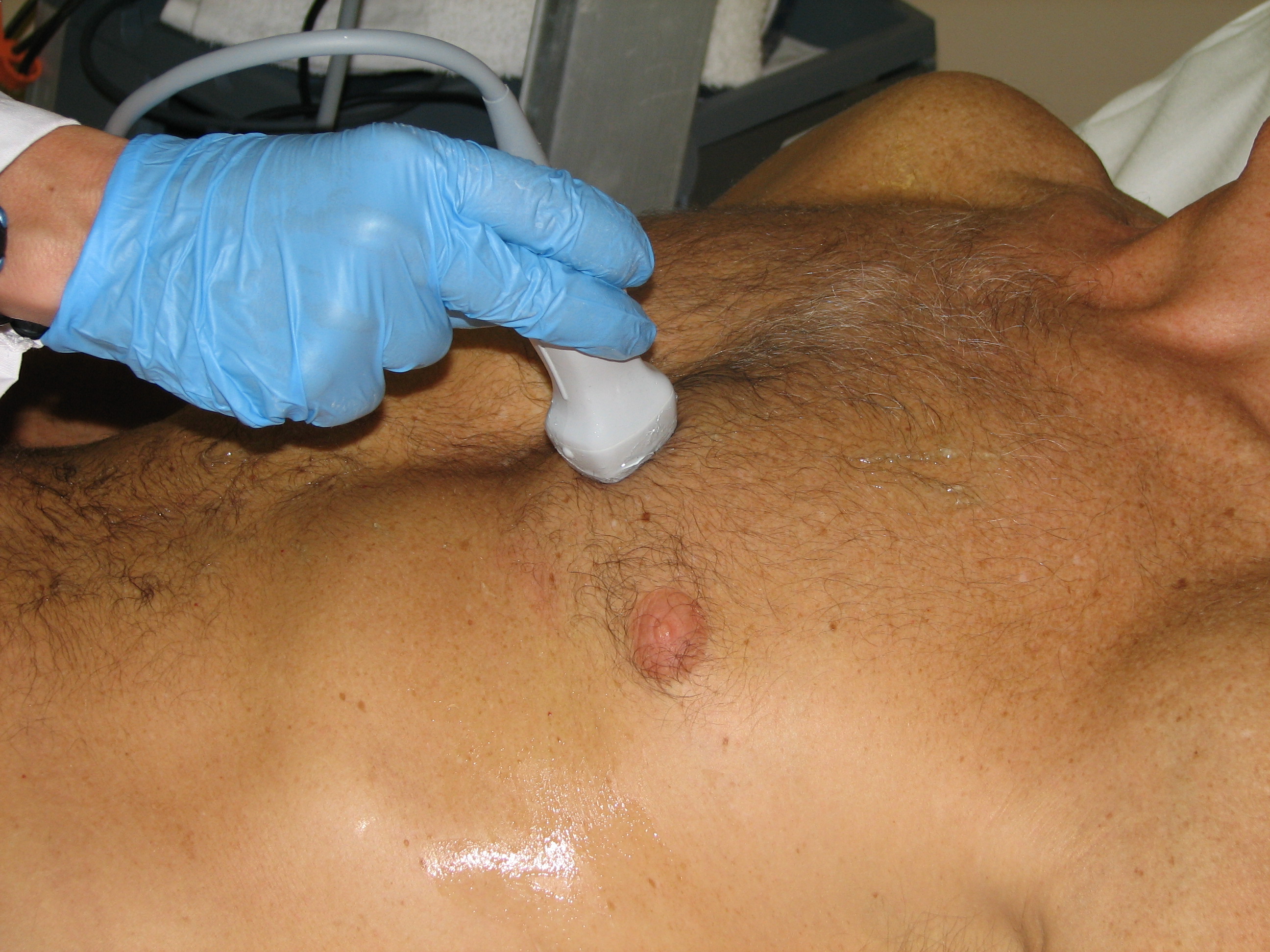
When you have that bad trauma case or that sick patient and you’re trying to assess their cardiac contractility or for pericardial effusion/tamponade, you try the subxiphoid (SX) view first, but despite the tricks outlined in a prior post, you still can’t get it. So, you move to the parasternal long (PSL) view on the left anterior chest, at the 3rd-4th intercostal space:

… and still can’t get a good view, and you think: “What am I doing wrong?!!!” – and then you think of just giving up…. well, let me give you a few tricks that may help. If the patient is able to turn on their left side, then great, if not, it’s ok. Continue reading

SonoApp/News: “The window to the soul!” Intracranial Pressure by Ocular Ultrasound

One day, years ago, I went to my ophthalmologist who looked in my eye through their ‘whatchamacallit’-scope and then sat back in his chair and asked me (with a straight face): “Are you having any diarrhea?” Of course, this immediately confused me as I wondered whether my years of medical training lacked the concept that my eye could assess diarrhea. I answered with a chuckling, “no” and he concluded with, “ok, then Im sure it’s fine.” I decided to just forget that odd encounter until I started to perform ocular ultrasounds several years ago, excited about how I now dont have to rely on my horrible fundoscopic technique as it gives tons of information not only about the eye, but also the brain! Continue reading

SonoNews: American Institute of Ultrasound in Medicine (AIUM) Practice Guidelines released

AIUM  – an organization that truly is an “institute” that is all about ultrasound – it used to be a community of only radiologists, but over the last few years, as bedside ultrasound has become part of many other specialties, there are now more sections for those specialties to become their own ‘community within a community’ – so to speak. Emergency physicians who are ultrasound enthusiasts, of course, are a growing section within AIUM – and if you ever want to meet every single leader in bedside ultrasound, this is the conference to go to! They also have AIUM and ACEP joint workshops in bedside US and promote research among all specialties. AIUM has been releasing their Practice Guidelines of each application and has recently completed quite a few. Each specialty define their own use of bedside ultrasound, and there are “complete” and “limited” (or “focused”, which may not include every detail listed under the AIUM guideline) scans, but its always nice to see what AIUM considers as their guideline to others. Continue reading

SonoCase: good one by a good friend – 28yr old abdominal pain on EPMonthly!

Teresa Wu, Associate Residency Director, and Director of Ultrasound and Simulation Programs and Fellowships, for the Maricopa Emergency Medicine Program (otherwise known as “T Wu” – as shouting that loud over and over again gets even the innocent bystanders at the bar chiming in )- has joined her colleague, Brady Pregerson (who manages a free on-line EM Ultrasound Image Library and is the editor of the Emergency Medicine Pocketbook series) once again for a fantastic case highlighted in the recent issue of EP Monthly. Its about a 28 year old female walking in to the waiting room and telling the nurse she has abdominal pain Continue reading

SonoTip&Trick: “I can’t tell if there is normal lung sliding.” Here’s a quick tip….

All of us have had that case where we had a thoracic trauma victim or an acutely short of breath patient who we want to evaluate for pneumothorax. We use the ultrasound machine since it’s quick and more accurate than chest XRay. We place the linear probe on the anterior chest wall, indicator toward the head at the 2nd intercostal space and midclavicular line, and see this:

Continue reading

SonoCase: 57 yr old with acute chest pain, light-headed….

This case is one of the most interesting cases I have heard about. A true testament to the concept that with bedside US, know what normal looks like well – because if you see something that doesn’t look normal, you may not know what it is sometimes, but it’s not normal and it’s time to explore further. One of our stellar EM residents, Dr. Natatcha Chough, went to the bedside of this patient who was brought by ambulance with appreciable diaphoresis. He was 57 yrs old, c/o gradual onset of chest pressure radiating to his back for 40 minutes (which had resolved after paramedics gave nitroglycerin), feeling light head, with associated shortness of breath, wheezing. He had a history of hypertension and aortic coarctation repaired as a child and at age 20, no history of asthma/COPD, and takes Metoprolol daily.

His vitals: T 36.3  RR 24   HR 83   BP  87/55   O2 sat 93% RA Continue reading

SonoTexts: JAMA review on ultrasound texts – and a list of some of the best

I was flipping through the most recent issue of JAMA and noticed 2 book reviews in the end, both of which had to do with point-of-care ultrasound – yes! Its probably the only thing that would stop me in mid-bite of my midnight snack. One of the books highlighted is by Hadzic, a regional anesthesia book which recently added a section on US-guided nerve blocks – hot topic these days as has been well studied and taught by Mike Stone, Arun Nagdev, and others. Of course, the review done by Chris Moore about Chris Fox’s book, Atlas of Emergency Ultrasound was what got my attention: quite matter of fact about point-of-care ultrasound, which I appreciate. I loved that Chris Fox’s book is highlighted in JAMA. Period. Disclaimer: I am biased as he is the one who made me into an US believer during my residency at UC Irvine, and was the first SonoFiler I wrote about – great guy and good friend.

My favorite part of the review:

Continue reading

SonoTip&Trick: “I cant see the aorta, there’s too much gas.” Well did you try this?…

It’s frustrating when you’re trying to see the abdominal aorta, and there is gas scatter throughout your screen in all regions except the bifurcation. I had someone on our ultrasound elective say to me one day, “Can’t we just say “Pull my finger!” or have them let one go and it get better for us?” Well, definitely would not be better for us, and it also wouldn’t help your image acquisition on the screen either – I know, bummer. But there are 3 things you can do to try to improve your image acquisition: Continue reading

SonoCase: 62 year old male c/o general weakness… you “RUSH” to his bedside…

This case was diagnosed in 10 minutes of patient evaluation according to the resident on our ultrasound elective who performed the scan and the team caring for him in the emergency department. The team knew the diagnosis and, therefore, knew what to order quickly. The patient came with his wife by private vehicle into the triage area of the waiting room where he complained of feeling very weak, more and more over the last 2 days, gradual onset, and said he couldn’t catch his breath with just a few steps. His appetite was poor and wasn’t eating or drinking much, denies chest pain/fever/vomiting/diarrhea or bloody/dark stools. He has a history of metastatic lung cancer (on chemo), diabetes (on insulin), hypertension (on beta blocker), CHF (on lasix), and DVT (on Coumadin) – yeah, I know, survival of the fittest! From what I heard, he did have a smile on his face, so at least he had that going for him, which is so amazing to me – if only we could all be like that!

His vitals: T 36.7   RR  18   HR 90   BP 88/60   O2 sat 93% RA; code status: Continue reading